
NICE Proposes Five AI Tools to Help Read Prostate MRI Scans in the NHS
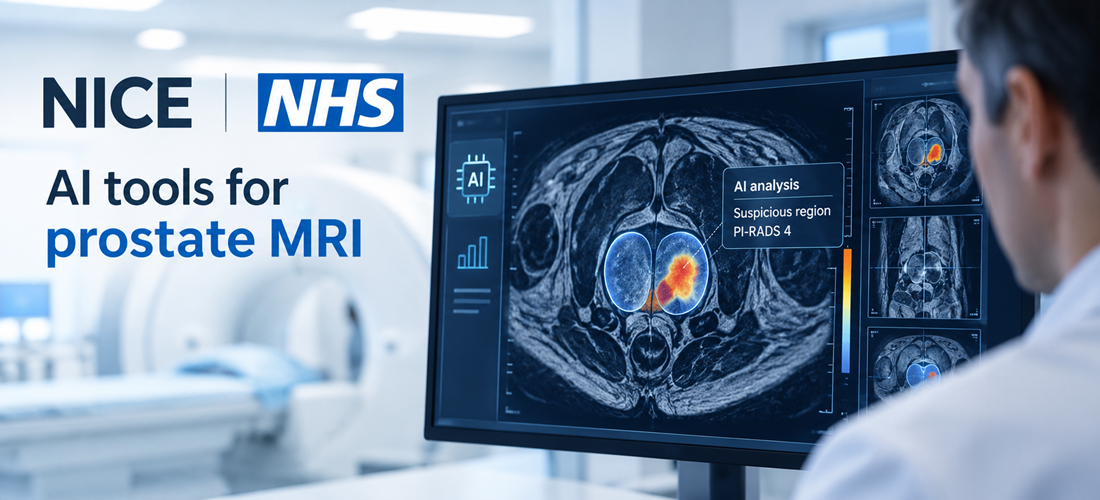
If you are waiting for a prostate MRI result, you may have seen headlines about artificial intelligence (AI) helping doctors spot prostate cancer. On October 23, 2026, the National Institute for Health and Care Excellence (NICE) announced a proposal that could bring these tools into wider use in the NHS.
What NICE announced
NICE, which develops healthcare guidance for England and Wales, published draft recommendations for five AI technologies to help radiologists, the doctors who read medical scans, review prostate MRI. The five tools selected are AI-Rad Companion Prostate MR, DeepHealth Prostate, ProstatID®, Prostate Intelligence (Pi), and QP-Prostate.
The tools highlight areas on the scan that may be suspicious for cancer, and some also outline suspected lesions (abnormal areas) and assign risk scores. NICE described them as a potential "second pair of eyes."
AI would support, not replace, the radiologist, who would still review the images and AI findings before decisions about patient care.
In 2019, NICE recommended offering MRI before biopsy as the first-line investigation for men with suspected prostate cancer that appears confined to the prostate. Research, including the UK PROMIS study and the international PRECISION trial, helped establish that MRI before biopsy could reduce unnecessary biopsies while improving the detection of clinically significant prostate cancer compared with traditional biopsy approaches.
As MRI has become a more routine part of prostate cancer evaluation, demand for these scans has increased. More than 58,000 men were diagnosed with prostate cancer in England in 2023, and that number is projected to rise.
Meanwhile, radiology services were already stretched by staff shortages. The Royal College of Radiologists' 2025 census found a 32% shortfall of consultant radiologists in the UK, a gap forecast to reach 40% by 2030 without action. Across complex imaging services, including CT and MRI, scan volumes grew by 9% in a year, compared with approximately 4% growth in the consultant radiology workforce.
NICE also notes that prostate MRI reporting differs across centers and can depend on the radiologist's expertise.
NICE's independent committee concluded that these technologies could improve the accuracy and consistency of prostate MRI interpretation, particularly where specialist expertise is less available. However, the available research is still limited, and results have not always been consistent.
NICE is proposing that the five tools be available as options for NHS use during a two-year evidence-generation period, subject to regulatory and evidence-collection requirements. During that time, researchers would study how well the tools perform in everyday care, including diagnostic accuracy, patient outcomes, costs, and performance across different groups of patients. NICE would review the evidence before making longer-term recommendations.
The guidance is still a draft and open to public consultation, so AI analysis will not immediately become part of every NHS prostate MRI review.
A prostate MRI, with or without AI, cannot confirm a cancer diagnosis on its own. Your report may use PI-RADS (Prostate Imaging Reporting and Data System) or a five-point Likert scale, which NICE guidance also uses. Both describe how suspicious an area appears; neither is a diagnosis.
A negative MRI lowers the risk of clinically significant prostate cancer (cancer more likely to pose a health risk and potentially need treatment), but it does not reduce that risk to zero.
Your physician will consider the MRI findings alongside other information, such as prostate-specific antigen (PSA, a protein measured in a blood test) levels and their trend over time, prostate size, family history, and previous biopsy results. A biopsy is usually needed to confirm a diagnosis. Not every prostate cancer requires immediate treatment, and for some patients with lower-risk cancer, active surveillance (regular monitoring) may be an appropriate option.
NICE's guidance concerns AI tools used by NHS radiologists. It is not an evaluation or endorsement of DeepView Imaging's patient-accessible service.
DeepView Imaging provides an AI-supported second analysis for people who have already had a prostate MRI, using ProstatID, which is FDA-cleared, CE-Marked, and UKCA-Certified. Patients receive visual overlays of suspicious areas that they can share with their physician. It does not replace the original radiology report or the judgment of a radiologist, urologist, or treating physician.
NICE's announcement reflects rising pressure on prostate MRI services and growing interest in AI to help, alongside a clear recognition that more evidence is needed. If you have had a prostate MRI, consider asking your physician what the scan revealed, how confident the findings are, and what is guiding the recommendation for your next steps.
This article is for educational purposes only and is not medical advice. Decisions about screening, biopsy, diagnosis, monitoring, or treatment should be made with your treating physician.
Sources
- National Institute for Health and Care Excellence (NICE). New AI tools could help spot prostate cancer more accurately. October 23, 2026.
- NICE. Draft healthtech guidance on AI technologies for prostate MRI (GID-HTG10879). In consultation.
- NICE. Final scope: AI technologies to help detect prostate cancer on MRI (GID-HTE10089). March 2026.
- NICE. Prostate cancer: diagnosis and management (NG131). May 2019, updated 2021; see also NICE news release on MRI before biopsy.
- Ahmed HU, El-Shater Bosaily A, Brown LC, et al. Diagnostic accuracy of multi-parametric MRI and TRUS biopsy in prostate cancer (PROMIS). The Lancet. 2017;389(10071):815–822.
- Kasivisvanathan V, Rannikko AS, Borghi M, et al. MRI-targeted or standard biopsy for prostate-cancer diagnosis (PRECISION). New England Journal of Medicine. 2018;378(19):1767–1777.
- The Royal College of Radiologists. Clinical Radiology Workforce Census 2025. Published June 2026.
- U.S. Food and Drug Administration. ProstatID, 510(k) K212783. Cleared July 8, 2022.
- Bot Image, Inc. ProstatID CE marking announcement, October 27, 2025, and UKCA certification announcement, November 18, 2025. Manufacturer announcements.