
New 2026 PSA Screening Guidelines: What the American Cancer Society Recommends
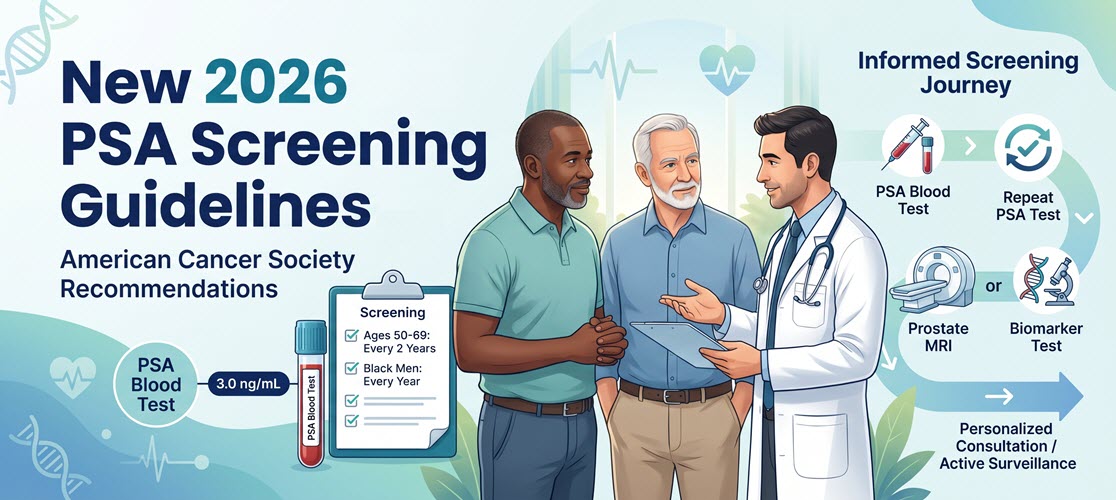
If you've ever asked whether you should get a PSA test and come away unsure, you're not alone. For years, the American Cancer Society's advice was to discuss the decision with your doctor, without a direct recommendation either way.
On November 12, 2026, that changed. The ACS now recommends regular PSA testing for most men in their 50s and 60s, citing stronger evidence that screening can reduce deaths from prostate cancer.
What changed in the new PSA screening guidelines?
PSA (prostate-specific antigen) is a protein produced by the prostate and measured with a blood test. An elevated level can be a sign of cancer, but it can also result from noncancerous conditions, such as benign prostatic hyperplasia (BPH, an enlarged prostate) or inflammation.
The new guideline sets starting ages and testing intervals based on risk:
- Most men aged 50 to 69: A PSA test every two years.
- Black men aged 45 to 69: Every year, reflecting their higher risk of developing and dying from prostate cancer.
- Men with a strong family history, aged 45 to 69: Every year. This means a father, brother, or son diagnosed before 65, or more than one of these relatives diagnosed at any age. Men with one such relative diagnosed at 65 or older are advised to test every two years from 45.
- Men aged 70 to 74: An individual decision with their physician. If screening continues, ACS recommends testing every two years.
- Men aged 75 and older: Screening is generally not recommended, although very healthy men aged 75 to 79 may discuss continuing. ACS discourages screening after 80 and for men with a life expectancy of less than 10 years.
Men with inherited gene changes such as BRCA2 may need a different approach and should discuss their individual risk with a physician.
Screening also has potential downsides. PSA testing can lead to false alarms, unnecessary biopsies, or detection of slow-growing cancers that might never cause harm, and treatment can cause urinary, sexual, or bowel problems. The guideline uses follow-up testing and active surveillance to help reduce these risks.
ACS considers a PSA of 3.0 ng/mL or higher elevated for men aged 45 to 69, and 6.5 ng/mL or higher for men aged 70 to 74. These thresholds signal the need for further evaluation; they do not establish a diagnosis.
An elevated result should generally be repeated two weeks to three months later, because PSA can rise for temporary reasons. If it stays elevated, most men should be offered a prostate MRI, a validated biomarker test (a specialized blood or urine test), or both, to help decide whether a biopsy is needed. Some men with particularly concerning findings may be advised to go directly to biopsy. If your MRI is normal, see Elevated PSA, Normal MRI: What Happens Next?
Decisions also depend on the broader clinical picture, including PSA trends, prostate size, family history, age, previous biopsy results, and overall health. The same PSA result can carry different implications for different patients.
If a biopsy confirms low-risk prostate cancer, ACS recommends offering active surveillance first. This means monitoring the cancer with PSA tests, and possibly repeat MRIs and biopsies, and starting treatment only if there are signs it is becoming more aggressive. To learn how doctors judge which cancers need treatment, see What "Clinically Significant" Prostate Cancer Actually Means.
Advice still differs depending on where you live.
- U.S.: The American Urological Association (AUA/SUO) guideline, updated in 2026, supports screening every two to four years from 50 to 69, starting earlier for higher-risk men. The U.S. Preventive Services Task Force's most recent final recommendation, from 2018, advises an individual decision for men aged 55 to 69.
- UK: In 2026, the UK National Screening Committee recommended against screening all men, supporting PSA testing every two years only for men aged 45 to 61 with a harmful BRCA2 gene variant and a relevant family history. The UK government accepted this for England, with rollout expected in 2027, and is expanding the TRANSFORM screening trial to invite all eligible Black men. Other men can still discuss PSA testing with their GP.
- Europe: The European Association of Urology supports a risk-adapted approach, and the European Union encourages countries to explore organized, risk-based screening programs.
A prostate MRI can help physicians identify suspicious areas, assess the likelihood of clinically significant prostate cancer (cancer more likely to grow or spread), and guide targeted biopsies when needed.
Suspicious areas are commonly scored using PI-RADS (Prostate Imaging Reporting and Data System), or a five-point Likert scale in some UK settings. These scores describe how suspicious an area appears; they do not confirm cancer. Our guide on how to read your prostate MRI results explains more.
A negative MRI lowers the risk of clinically significant cancer, but it does not reduce the risk to zero, and interpretation can vary with scan quality, lesion location, and the radiologist's experience. Physicians weigh MRI findings alongside PSA density (PSA level divided by prostate volume), PSA trends, family history, and previous biopsy results.
AI-supported analysis may help highlight areas that deserve closer attention, but physician judgment remains central. DeepView Imaging offers an AI-supported second analysis of an existing prostate MRI using Bot Image's ProstatID software, which is FDA-cleared, CE-Marked, and UKCA-Certified. Its color-overlay report gives patients and their care team another perspective on information already contained in the MRI, and it does not replace a radiologist, urologist, or treating physician. If you'd like a copy of your scan, see How to Get a Copy of Your Own Prostate MRI.
The American Cancer Society's 2026 update marks a shift toward regular PSA screening, particularly for men aged 50 to 69 and those at higher risk. It also makes clear that an elevated PSA should usually lead to careful evaluation, using repeat testing, MRI, and biomarker tests, before decisions about biopsy or treatment.
If you're approaching screening age, have a family history of prostate cancer, or have already received an elevated PSA result, talk with your physician about your individual risk and what your next steps could be.
Sources
- American Cancer Society. American Cancer Society Updates Prostate Cancer Screening Guideline. Press release, November 12, 2026.
- Hoffman RM, Wolf AMD, Etzioni R, et al. American Cancer Society Guideline for the Early Detection of Prostate Cancer, 2026. CA: A Cancer Journal for Clinicians. 2026;e70112. doi:10.3322/caac.70112.
- Lin DW, Carlsson S, Filson CP, et al. Updates to Early Detection of Prostate Cancer: AUA/SUO Guideline (2026). The Journal of Urology. 2026.
- U.S. Preventive Services Task Force. Prostate Cancer: Screening. Final recommendation, 2018.
- UK National Screening Committee. Prostate Cancer Screening Recommendation. 2026.
- UK Department of Health and Social Care. Major expansion of research and treatment for prostate cancer. June 2, 2026.
- UK Health Security Agency / Department of Health and Social Care. Advising well men about the PSA test for prostate cancer: information for GPs.
- European Association of Urology. EAU Guidelines on Prostate Cancer. Current edition.
- Council of the European Union. Council Recommendation of December 9, 2022, on Strengthening Prevention Through Early Detection.
- U.S. Food and Drug Administration. ProstatID, 510(k) K212783. Cleared July 8, 2022.