September is Prostate Cancer Awareness Month.
Learn the facts and understand your options.
Learn the facts and understand your options.

Few phrases in a prostate report cause more quiet confusion than "clinically significant." It sounds like a judgment about how serious your situation is, and in a sense it is, though not in the way most people assume when they first read it.
Understanding the term helps because it sits underneath almost every decision you may face: whether to have a biopsy, whether to treat, and whether careful monitoring is a reasonable path.
Prostate cancer is unusual among cancers in how widely its behavior varies. Some prostate cancers grow quickly and can spread. Others grow so slowly that a man is far more likely to die with them than from them.
That difference created a real problem in medicine. Older biopsy methods sampled the prostate somewhat blindly and often turned up very small, very low-grade tumors that were unlikely to ever cause symptoms. Finding and treating those cancers exposed men to side effects without a clear benefit, a problem usually called overdiagnosis and overtreatment.
The phrase "clinically significant" was adopted to name the distinction: disease likely to grow, spread, or cause harm, separated from disease that may never do either.
Grade describes how abnormal the cancer cells look under a microscope after a biopsy. It is the single strongest predictor of how a prostate cancer is likely to behave.
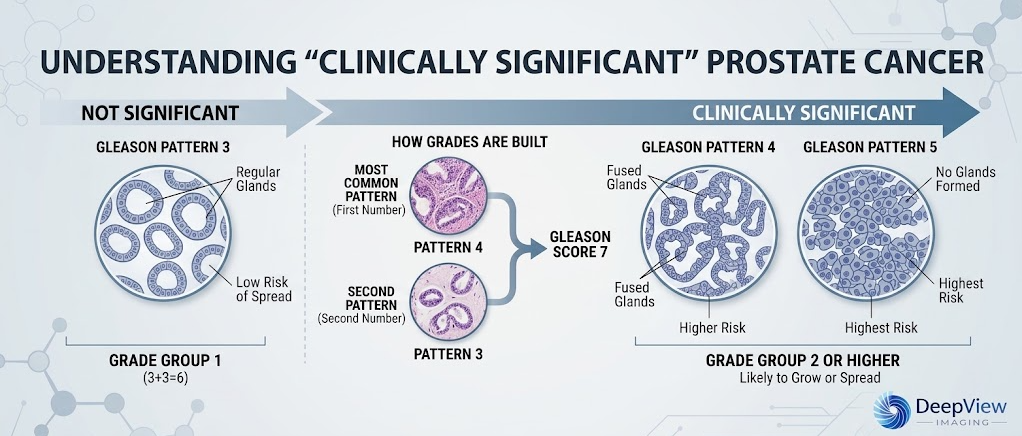
A healthy prostate is built from small, tidy, well-separated glands. When a pathologist examines biopsy tissue, they judge how far that architecture has drifted from normal and assign a Gleason pattern number:
Patterns 1 and 2 existed historically and are essentially no longer assigned to prostate biopsies, which is why the lowest score you will see in practice is a 6 rather than a 2.
Prostate cancer is often mixed, with more than one pattern present in the same tumor. So instead of reporting a single number, pathologists report two and add them together.
The first number is the pattern that makes up the majority of the cancer seen in the sample. The second number is another pattern present alongside it. On biopsy, this second number is usually the next most common pattern or the highest-grade pattern found, which means even a modest amount of a more aggressive pattern can change the score. Added together, they produce the Gleason score.
Order matters, and this is where many patients are caught off guard:
Both 3+4 and 4+3 total 7, yet they describe different tumors. In a 3+4, the more aggressive pattern is the minority component. In a 4+3, it dominates. Published analyses have reported meaningfully worse outcomes for 4+3 cancers than for 3+4 cancers, with one report describing roughly a threefold higher rate of lethal outcome, which is why the two are placed in separate Grade Groups.
Because a Gleason 6 sounded alarming on a scale that theoretically runs to 10, the International Society of Urological Pathology introduced the Grade Group system in 2014, numbering the categories 1 through 5. Grade Group is now the most common way prostate cancer is graded in the UK and is used alongside Gleason scores in the U.S. and Europe. Both may appear on your report, and they describe the same finding.
In most studies and trials, Grade Group 1 is treated as insignificant disease and Grade Group 2 or higher is counted as clinically significant. That threshold exists because the presence of any pattern 4 signals more potential for growth and spread. Cancers made up only of pattern 3 carry very little risk of death from prostate cancer.
The line is a useful convention rather than a biological wall. Researchers continue to debate how much a very small amount of pattern 4 actually changes a man's outlook, since some studies suggest cases with only a few percent of pattern 4 behave much like Grade Group 1 disease.
This is why "clinically significant" does not automatically mean "treat immediately." The 2026 AUA/ASTRO guideline in the U.S. recommends active surveillance as the preferred management for low-risk prostate cancer, and the 2026 EAU guidelines in Europe describe active surveillance as appropriate for low-risk disease and for selected men with favorable intermediate-risk Grade Group 2 lesions.
Grade is the anchor, though it is rarely read in isolation. Physicians weigh PSA level and trend, PSA density, prostate volume, how many biopsy cores are involved, MRI findings and PI-RADS or Likert score, lesion location, age and life expectancy, family history, ancestry where clinically relevant, symptoms, and other health conditions.
Grading also has human limits. Assigned grades can shift between pathologists, and a biopsy can under-sample a tumor, so the grade on a biopsy sometimes differs from what is found later. Two men with identical Grade Group 2 results can reasonably end up on very different paths.
For more information see: Understanding Your PI-RADS Score
This distinction explains a shift in how prostate MRI is used. The goal of an MRI before biopsy is to raise the odds of finding meaningful disease while reducing the chances of stumbling onto tiny, harmless tumors. EAU guidance recommends MRI to help avoid unnecessary biopsies, and when biopsy is performed, combining targeted and regional sampling.
MRI cannot make the call by itself. It identifies areas that look suspicious and helps guide where a needle should go. MRI also tends to pick up cancers that later prove to be higher grade, which is precisely the point of using it. Diagnosis and grading still depend on tissue examined by a pathologist. A PI-RADS score describes how suspicious an area appears on MRI; it is not the same as a diagnosis, and a negative MRI lowers risk without reducing it to zero.
DeepView Imaging provides an AI-supported second analysis of a prostate MRI using ProstatID™, which is FDA-cleared, CE-Marked, and UKCA-Certified. The goal is to give patients and their care team another perspective on information already contained within the MRI, with visual overlays highlighting regions the software scores as suspicious. AI-supported analysis may help flag areas that deserve closer attention, though physician judgment remains central. DeepView Imaging does not replace a radiologist, urologist, or treating physician, and patients can share their results with their physician when discussing next steps.
"Clinically significant" is medicine's way of separating prostate cancer that is likely to matter from prostate cancer that may never cause trouble. It rests largely on grade, where the two Gleason numbers tell you which growth patterns are present and which one dominates, and where Grade Group 2 and above is generally counted as significant. That grade is then interpreted alongside your PSA, imaging, biopsy details, age, and health. If the phrase appears in your report, a good question for your doctor is simply: what makes my cancer fall where it does, and what does that mean for my options?
Disclaimer
This article is for educational purposes only and is not medical advice. Decisions about screening, biopsy, diagnosis, monitoring, or treatment should be made with your treating physician.
.svg)