September is Prostate Cancer Awareness Month.
Learn the facts and understand your options.
Learn the facts and understand your options.


If you have had a digital rectal exam and your doctor said everything felt normal, it is natural to wonder what that result really means. Does a normal exam mean prostate cancer has been ruled out?
The short answer is no. A normal digital rectal exam can be reassuring, but it cannot rule out prostate cancer by itself. The reason has less to do with the skill of the physician and more to do with the anatomy of the prostate and the limits of what any single test can show.
A digital rectal exam (DRE) is a brief physical exam. The physician inserts a gloved, lubricated finger into the rectum to feel the prostate, which sits just in front of the rectal wall. The goal is to assess features such as the gland's size, shape, symmetry, and firmness, and to check for areas of hardness or a lump (nodularity).
An unexpected finding may prompt further evaluation, and the exam still offers information a blood test cannot. But it has one built-in limit: the physician can feel only the part of the prostate that sits against the rectal wall. The rest of the gland is out of reach.
Many people picture the prostate as a small gland that can be checked completely by touch. In practice, only part of it is accessible during a DRE, mainly the posterior portion (the back of the gland, closest to the rectum).
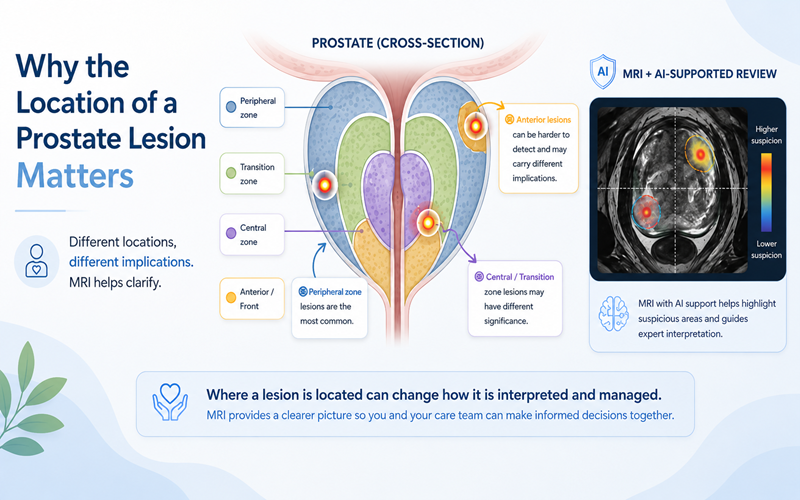
It also helps to know that the prostate is not one uniform structure. It is made up of several zones:
A careful, thorough exam can still leave parts of the prostate, especially the front and the deeper areas, largely unassessed.
Because the peripheral zone sits toward the back of the gland, some cancers that begin there are close enough to the rectal wall to create a change a physician can feel, such as firmness, an irregular surface, or a loss of normal symmetry. Historically, this is part of why the DRE became a common prostate test.
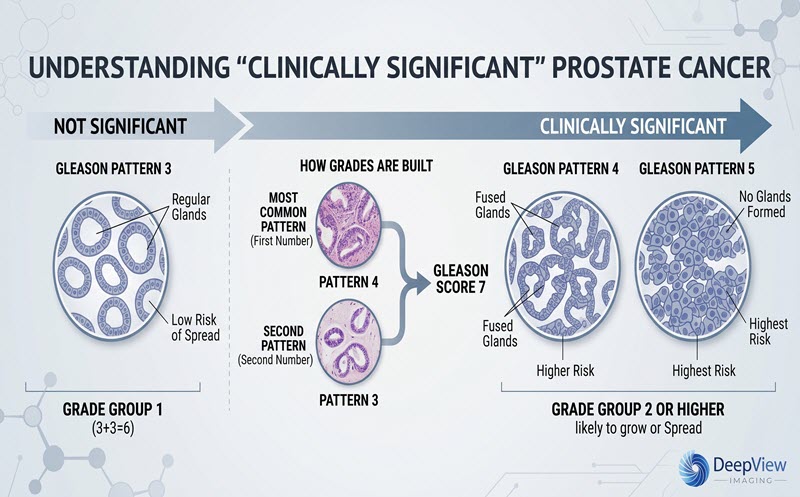
Tumors toward the front of the gland are a different story. An anterior lesion can sit too far from the examining finger to produce any detectable change. A cancer in that location can be clinically significant (the term doctors use for cancer likely to grow or spread and to warrant treatment) yet still feel completely normal on a DRE, simply because of where it is. That is one reason a normal exam does not, on its own, settle the question.
For many years the DRE was treated as a frontline screening test. That thinking has shifted.
In the United States, the 2023 AUA/SUO guideline no longer recommends DRE as a stand-alone screen. It describes the exam as optional, used alongside the prostate-specific antigen (PSA) blood test rather than on its own, and most useful when the PSA is already somewhat elevated.
In the United Kingdom, NICE guidance has, since 2019, pointed to MRI as the first detailed investigation when prostate cancer is suspected, and has questioned the need for routine DRE where MRI is available. In Europe, the EAU folds the DRE into a broader, risk-adapted approach alongside PSA and imaging.
The common thread across regions is that the DRE is now seen as one input among several, not a test that can confirm or exclude cancer by itself.
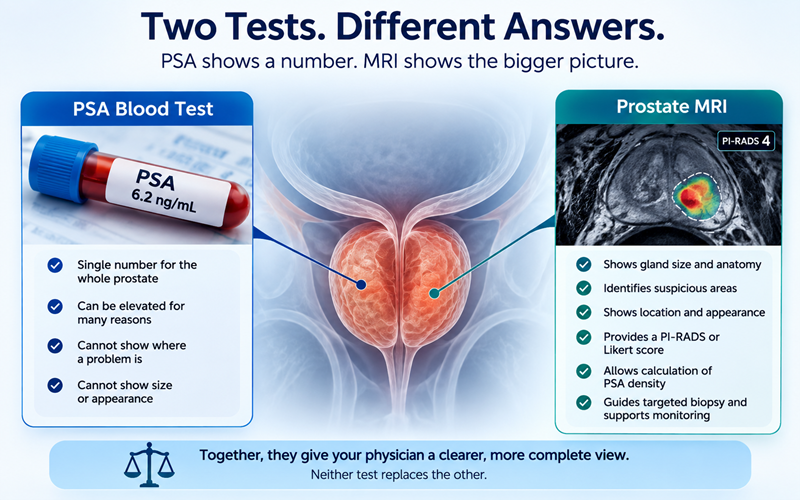
Because no single test tells the whole story, physicians weigh several factors together. These often include the PSA level and how it changes over time, PSA density (the PSA relative to prostate size), prostate volume, MRI findings, family history, age, ancestry where relevant, symptoms, prior biopsy results, and a patient's own preferences.
Similar numbers can mean different things in different people. A given PSA may be reassuring in a man with a large prostate and more concerning in a man with a small one. It is also worth knowing that a small number of aggressive cancers occur in men whose PSA looks normal, which is part of why clinicians rarely rely on one result alone.
It is also important to understand what these tests do and do not do. None of them diagnoses cancer on its own. A diagnosis generally depends on a biopsy, in which small tissue samples are examined under a microscope. Blood tests and imaging help decide whether a biopsy is warranted and, if so, where to aim it.
A prostate MRI (magnetic resonance imaging) gives a detailed, three-dimensional view of the whole gland, including the front and deeper areas a finger cannot reach. It can highlight suspicious areas, help guide a targeted biopsy, and support monitoring over time.
MRI is valuable, but it is not perfect. It can miss some clinically significant cancers, and results depend on scan quality, the area involved, and the experience of the person reading the images. A negative MRI lowers the likelihood of significant cancer, but it does not reduce the risk to zero.
To describe how suspicious an area looks, radiologists use scoring systems. PI-RADS (Prostate Imaging Reporting and Data System) is widely used in the United States and Europe; in the UK, NICE also uses a 5-point Likert scale. A higher score means an area looks more suspicious, though a score describes suspicion rather than a diagnosis.
For more information about PI-RADS see: Understanding Your PI-RADS Score
Because interpretation can vary, a second review of the same images can add useful perspective. In recent years, artificial intelligence (AI) has become one more layer in that process. AI-supported analysis can examine the full imaging dataset, flag regions that may deserve closer attention, and provide measurements such as prostate volume. It is designed to support clinicians as they interpret a scan, and how much it adds in routine practice is still an active area of study.
This is the kind of perspective DeepView Imaging is designed to offer. A man who already has a prostate MRI can securely upload it and receive an AI-supported second analysis, powered by ProstatID, with color overlays that highlight areas of interest on the scan. ProstatID is cleared for prostate MRI analysis (FDA-cleared in the U.S., CE-Marked in the EU, and UKCA-Certified in the UK). DeepView Imaging gives patients and their care team another perspective on information already contained within the MRI, and the report is meant to be shared and discussed with a treating physician. It does not replace a radiologist, urologist, or other treating physician, and it does not provide a diagnosis.
For more information about MRI results, see: How to Read Your Prostate MRI Results
A normal digital rectal exam can be a good sign, but it cannot rule out prostate cancer, largely because a finger can reach only part of the gland. That is not a flaw in your physician's technique; it reflects the prostate's anatomy and the limits of any one test. Modern prostate care leans on several sources of information together, including PSA, MRI, and, when appropriate, additional review of the images. If you have questions about your own results, the most useful next step is a conversation with your care team about what the full picture suggests for you.
Disclaimer: This article is educational, isn't medical advice, and decisions should be made with your treating physician.
.svg)