September is Prostate Cancer Awareness Month.
Learn the facts and understand your options.
Learn the facts and understand your options.


When most people hear the words "second opinion," they think about getting another doctor's recommendation before surgery or treatment.
But what about getting a second look at the MRI itself?
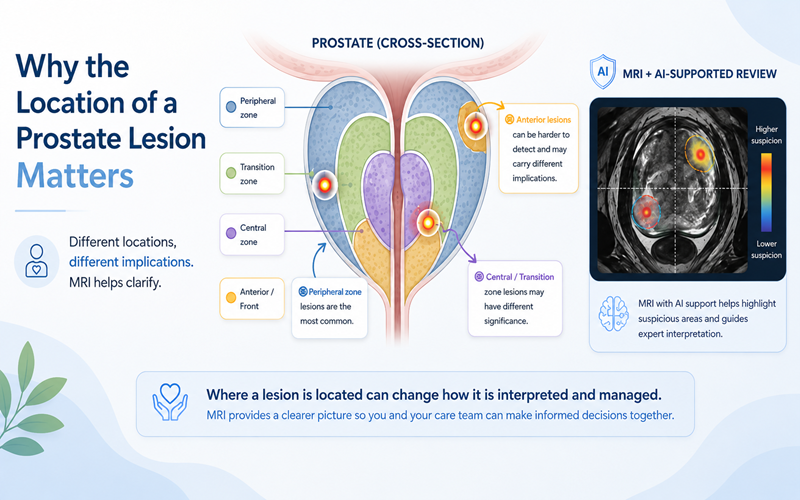
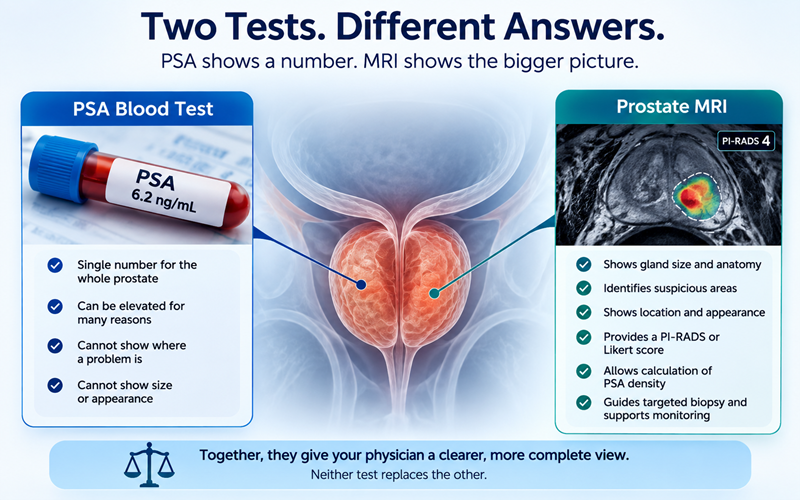
Many prostate cancer patients don’t realize that an MRI contains a great deal of information within the images. These details can be interpreted differently depending on the quality of the scan, the reader’s prostate MRI experience, the clinical context, and whether additional tools are used to support the review.
That's one reason some patients seek an additional review of their MRI images before making important decisions about biopsy, active surveillance, surgery, or radiation treatment.
That doesn't necessarily mean something was missed. It means medical imaging is often more nuanced than people realize.
Imagine you're looking at an aerial map of a city you've never visited.
At first glance, you can identify the major roads, neighborhoods, and landmarks. But someone who has spent years studying that city might notice shortcuts, hidden paths, and details that others overlook.
Prostate MRI can be similar. The images themselves don't change. But different tools, different perspectives, and different levels of experience may uncover additional information within the same scan.
This is one reason some patients seek a second review of their MRI.
Most people assume MRI works like taking a photograph. The machine captures the image and the answer is obvious. In reality, interpreting an MRI is closer to solving a puzzle.
A prostate MRI can contain hundreds or even thousands of images. Radiologists analyze subtle differences in tissue appearance, shape, diffusion characteristics, and other imaging features to determine whether an area appears suspicious. When contrast is used, they may also evaluate how tissue enhances after contrast injection.
Some findings are obvious. Others are far more subtle.
In some cases, a small abnormality may blend into surrounding tissue. In other situations, normal anatomy can resemble something concerning.
The challenge isn't simply seeing the image. It's understanding what the image means.
For years, patients who wanted additional reassurance typically sought a second opinion from another specialist. Today, a new option is emerging: artificial intelligence.
Think about modern navigation systems. Most drivers know how to get from Point A to Point B. But GPS systems can alert you to traffic, road closures, or alternate routes you may not have noticed on your own. The GPS isn't driving the car. It's providing additional information.
Researchers are exploring whether AI can serve a similar role in medical imaging. Rather than replacing radiologists, AI systems are trained on thousands of previous MRI scans and learn to recognize imaging patterns associated with clinically significant prostate cancer. The technology reviews the same images and highlights areas that may deserve closer attention.
In other words, AI is not making a diagnosis. It is helping uncover information that may already exist within the MRI.
Every patient situation is different, but a second review may help:
For some patients, the second review confirms the original report entirely. That can be valuable in itself. Confidence matters when making important healthcare decisions.
When people think about cancer detection, they often focus on whether cancer was found or missed. But there is another side to the story.
Sometimes a second review helps explain why something may not be cancer. Certain normal structures inside the prostate can occasionally resemble suspicious findings on MRI. Inflammation, prior infection, scar tissue, or benign enlargement can sometimes create confusing appearances.
Additional review may help distinguish between findings that are concerning and those that are not. In other words, a second review isn't only about finding more problems. Sometimes it's about avoiding unnecessary worry.
Many patients believe the MRI is the final answer. In reality, the MRI is often just one part of a larger decision-making process.
The MRI report may influence:
Because these decisions can have long-term implications, some patients want as much confidence as possible that the MRI findings have been thoroughly evaluated.
Imagine receiving a home inspection before purchasing a house. The inspector walks through every room and gives you a report. Most people would feel comfortable with that report.
But if you were about to make one of the biggest financial decisions of your life, you might appreciate having a second set of eyes review the property as well.
Not because you distrust the first inspection. Because the decision matters. For many men, decisions about biopsy, active surveillance, surgery, or radiation carry significant long-term implications.
Some patients seek additional review simply because they want the greatest possible confidence that all available information has been considered.
A prostate MRI is one of the most powerful tools available for evaluating the prostate, but like any complex medical test, its value depends not only on the images that are acquired but also on how much information can be extracted from those images.
Seeking a second review is not about questioning your healthcare team. It's about gathering as much information as possible before making important decisions about your health.
Sometimes a second review confirms exactly what was already reported. Sometimes it provides additional perspective. Either way, many patients find that having another way to evaluate the same MRI, whether through additional expert review, advanced analysis, or emerging AI technologies, helps them move forward with greater understanding, confidence, and peace of mind.
.svg)