

Prostate Cancer Awareness Month
Know the Facts.
Understand Your Options.
September is a time to learn about prostate cancer and the information that can help you take part in your care. Whether you are asking about PSA, supporting someone with a diagnosis, or trying to understand an MRI, start with reliable facts and a conversation with your physician.
Prostate cancer in the U.S.
American Cancer Society, 2026 estimates
333,830
New U.S. prostate cancer cases projected in 2026.
(about 915 / day)
1 in 8
Men will be diagnosed in their lifetime.
> 99%
5-year relative survival if diagnosed when the cancer is still confined to the prostate



Behind these numbers are individuals and families.
Understanding your risk and the purpose of each test can help you prepare for conversations about your care.
Understanding your risk and the purpose of each test can help you prepare for conversations about your care.
Not every prostate cancer needs treating
Prostate cancer covers a wide range of behavior. Some cancers grow so slowly that they would never have caused symptoms or affected how long a man lives. Others are more aggressive and benefit from treatment.
This is why physicians talk about clinically significant prostate cancer, usually meaning Grade Group 2 or higher (Gleason 7+), and why prostate MRI is aimed at that target rather than at finding every possible cancer.
For men with low-risk disease, guidelines in the U.S., Europe and the UK all support active surveillance as an option. That means monitoring with periodic PSA tests, imaging and sometimes repeat biopsy, with treatment held in reserve if the picture changes.
Finding a cancer and treating a cancer are separate decisions. Having accurate information about the current state of the disease and its progression helps your clinical team guide you on which decision is recommended.
This is why physicians talk about clinically significant prostate cancer, usually meaning Grade Group 2 or higher (Gleason 7+), and why prostate MRI is aimed at that target rather than at finding every possible cancer.
For men with low-risk disease, guidelines in the U.S., Europe and the UK all support active surveillance as an option. That means monitoring with periodic PSA tests, imaging and sometimes repeat biopsy, with treatment held in reserve if the picture changes.
Finding a cancer and treating a cancer are separate decisions. Having accurate information about the current state of the disease and its progression helps your clinical team guide you on which decision is recommended.
Know what can affect your risk

Age
Prostate cancer is rare in men under 40 but rises rapidly after age 50. About 6 in 10 diagnoses occur in men aged 65 or older, with an average age at diagnosis around 67.


Family History
While most prostate cancers occur in men without a family history of it, having a father or brother with prostate cancer more than doubles a man's risk of developing the disease. The risk is even higher if multiple family members have the disease.
Race / Ethnicity
Men of African ancestry are more likely to develop prostate cancer, and at an earlier age, than men of other races. The reasons for racial and ethnic differences are still unclear.

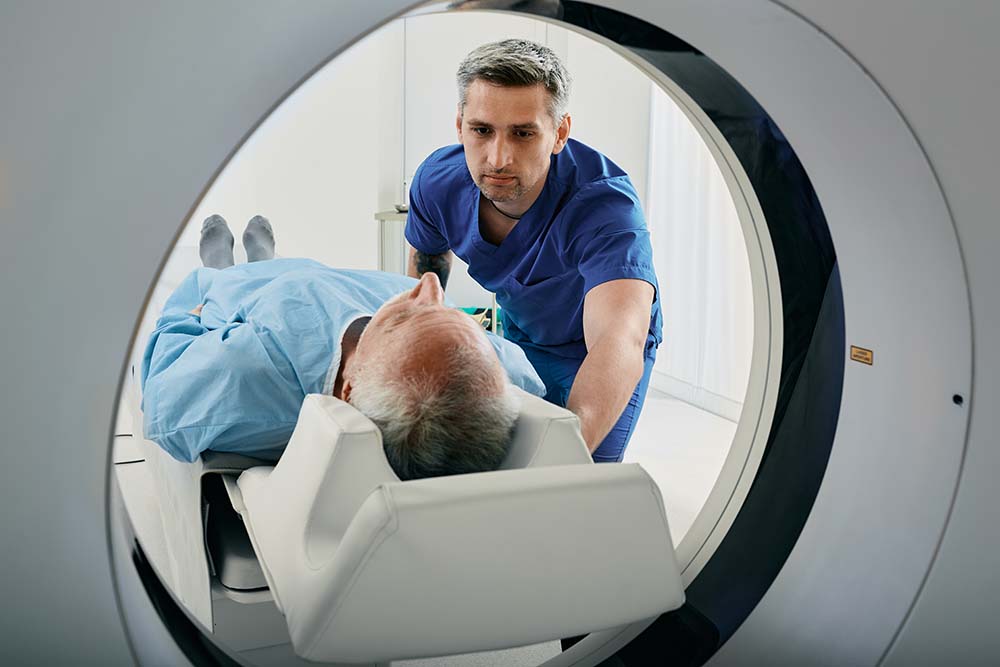
Gene Changes
Certain inherited changes to genes BRCA1 or BRCA2 are linked to breast, ovarian and other cancers, and can increase the risk of prostate cancer.
Men with Lynch syndrome (HNPCC) are also at increased risk for prostate cancer.
Men with Lynch syndrome (HNPCC) are also at increased risk for prostate cancer.
Early prostate cancer usually causes no symptoms
Prostate cancer confined to the prostate often produces no symptoms at all.
That is why it is usually found through testing rather than because a man feels unwell.
Urinary changes such as going more often, a weaker stream, or getting up at night are common in men over 50. More often they are caused by benign prostatic hyperplasia (BPH), a noncancerous enlargement of the prostate, or by inflammation. They are worth mentioning to your physician, and on their own they are not a sign of cancer.
Symptoms such as bone pain or unexplained weight loss are not typical of early disease and should be discussed with a doctor without delay.
That is why it is usually found through testing rather than because a man feels unwell.
Urinary changes such as going more often, a weaker stream, or getting up at night are common in men over 50. More often they are caused by benign prostatic hyperplasia (BPH), a noncancerous enlargement of the prostate, or by inflammation. They are worth mentioning to your physician, and on their own they are not a sign of cancer.
Symptoms such as bone pain or unexplained weight loss are not typical of early disease and should be discussed with a doctor without delay.
PSA, MRI, and Biopsy
answer different questions
PSA Blood Test

Measures a protein produced by the prostate. An elevated result can have cancerous or noncancerous causes.
Learn more: National Cancer InstituteProstate MRI

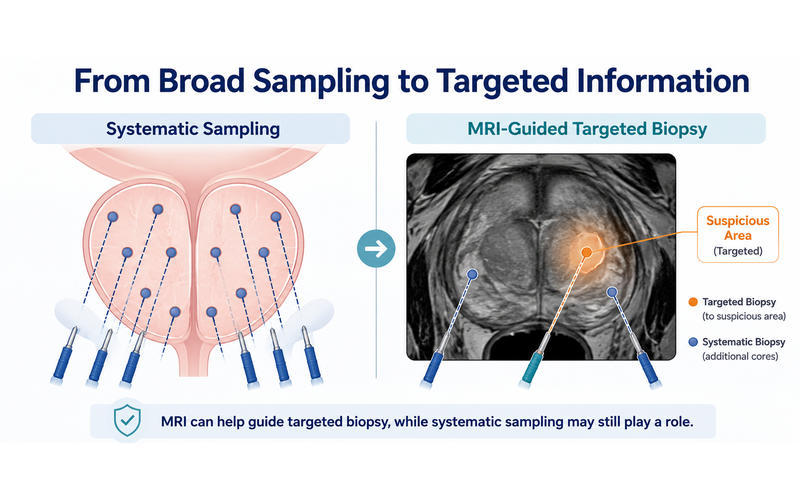
Provides detailed images that can help physicians evaluate suspicious areas and plan a targeted biopsy.
Biopsy & Pathology

Examines tissue samples from the prostate to establish a diagnosis and assess cancer characteristics.
Your physician considers test results together with your history and other risk information.
Progress worth knowing about
Shorter MRI scans: evidence from the PRIME trial
The 2025 PRIME trial evaluated prostate MRI without the contrast-enhanced portion of the scan. Among 490 participants in the primary analysis, this shorter approach met the study’s criterion for comparable detection of clinically significant prostate cancer. Adequate image quality was essential.
Why it matters: shorter, less resource-intensive scans could help imaging services expand access. Your physician and imaging team determine the appropriate protocol.
Source: PRIME trial, JAMA, 2025.
Why it matters: shorter, less resource-intensive scans could help imaging services expand access. Your physician and imaging team determine the appropriate protocol.
Source: PRIME trial, JAMA, 2025.

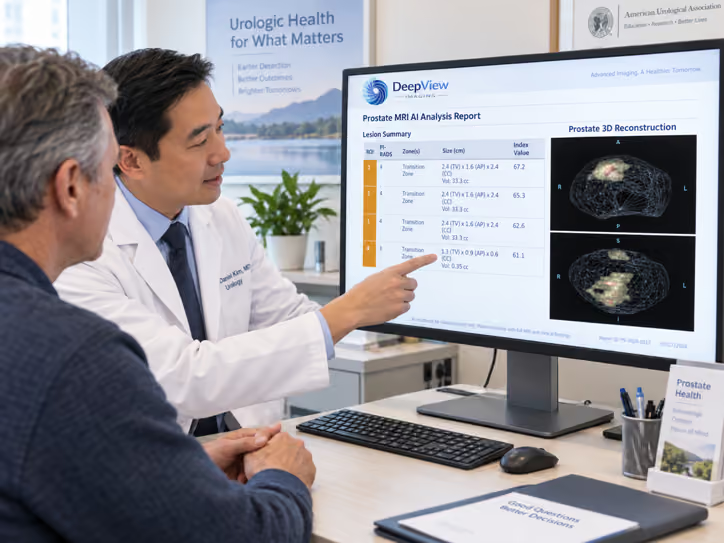
AI adds another source of information from MRI
AI is being used more often by radiologists and urologists to provide another perspective on MRI studies to help either confirm initial findings or highlight other areas of concern.
DeepView uses FDA-cleared ProstatID™ to analyze existing prostate MRI images and highlight areas suspicious for clinically significant prostate cancer. Patients receive software-generated output to review with their physician.
Learn more about our: AI Technology
DeepView uses FDA-cleared ProstatID™ to analyze existing prostate MRI images and highlight areas suspicious for clinically significant prostate cancer. Patients receive software-generated output to review with their physician.
Learn more about our: AI Technology
A new treatment option for a defined group with metastatic disease
On July 31, 2026, the FDA approved Pluvicto with androgen receptor pathway inhibitor therapy for adults with PSMA-positive metastatic androgen pathway modulation-naïve or-sensitive prostate cancer, previously called metastatic hormone-sensitive prostate cancer.
Why it matters: this expands an option for a specific group with advanced disease. Eligibility, benefits, and risks require discussion with an oncology team.
Source: FDA July 2026 announcement.
Why it matters: this expands an option for a specific group with advanced disease. Eligibility, benefits, and risks require discussion with an oncology team.
Source: FDA July 2026 announcement.

A trend worth watching
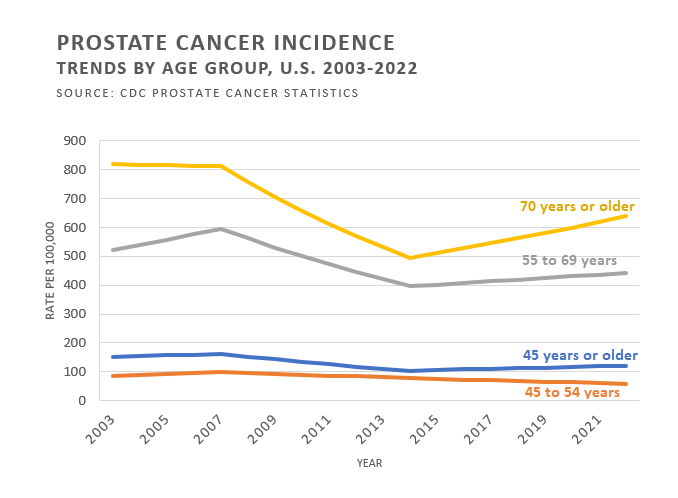
Prostate cancer diagnoses in the U.S. fell sharply between 2007 and 2014, then began rising again. From 2014 through 2022 the incidence rate increased by about 2.9% per year, and the steepest increases were in more advanced disease. Regional-stage diagnoses rose about 4.6% per year from 2013, and distant-stage about 5.6% per year from 2011.
Researchers are still working out how much of this reflects changes in screening patterns, changes in the population, or other factors.
Why it matters: five-year relative survival is about 38% when prostate cancer has spread to distant parts of the body, compared with above 99% when it is still confined to the prostate. Those distant-stage figures also reflect men diagnosed several years ago, before some current treatments were widely used.
Researchers are still working out how much of this reflects changes in screening patterns, changes in the population, or other factors.
Why it matters: five-year relative survival is about 38% when prostate cancer has spread to distant parts of the body, compared with above 99% when it is still confined to the prostate. Those distant-stage figures also reflect men diagnosed several years ago, before some current treatments were widely used.
Sources:
How suspicious areas on MRI are scored
When a prostate MRI shows an area of concern, the radiologist assigns a score describing how suspicious it appears. In the U.S. and much of Europe this is usually PI-RADS, a five-point scale published by the American College of Radiology. In the UK, NICE guidance also permits a five-point Likert scale, which many centers use.
Both run from 1, meaning clinically significant cancer is unlikely, to 5, meaning it is highly likely. A score describes how an area looks on imaging. It is not the same as a diagnosis, and it does not tell you the grade of any cancer that may be present. Diagnosis still depends on tissue from a biopsy.
Scores can also vary between readers, which is why we recommend a second-opinion interpretation.
Scan quality, the location of the lesion, reader experience and the clinical context all feed into the result, which is one reason your physician weighs the score alongside your PSA, your history and other findings rather than on its own.
Both run from 1, meaning clinically significant cancer is unlikely, to 5, meaning it is highly likely. A score describes how an area looks on imaging. It is not the same as a diagnosis, and it does not tell you the grade of any cancer that may be present. Diagnosis still depends on tissue from a biopsy.
Scores can also vary between readers, which is why we recommend a second-opinion interpretation.
Scan quality, the location of the lesion, reader experience and the clinical context all feed into the result, which is one reason your physician weighs the score alongside your PSA, your history and other findings rather than on its own.
Questions to Bring to Your Next Appointment
"How do my age and family history affect the testing we should discuss?”
“What might explain my PSA result, and what follow-up makes sense?"
"Would MRI add useful information in my situation?"
"What can my MRI tell us, and what can it miss?"
"If a biopsy is recommended, what question will it help answer?"
"If I have low-risk prostate cancer, is active surveillance an option?"
For some patients, care may involve active surveillance with planned follow-up rather than immediate treatment.
Your clinical team determines whether that approach is appropriate.
Your clinical team determines whether that approach is appropriate.
Already had a prostate MRI?
Your prostate MRI deserves a second look.
Prostate MRIs are among the most complex medical images to interpret, and studies show significant variability between readers. Research published in the American Journal of Roentgenology found that initial and second-opinion reports disagreed in 30% of cases—and in 86% of those disagreements, the second opinion was proven correct by surgical pathology.
Your MRI may contain subtle findings—small lesions, borderline scores, or areas that warrant closer review—that benefit from a second look. A focused re-analysis can confirm findings, clarify ambiguous areas, and give you greater confidence before making treatment decisions.
Second opinions are standard in cancer care. They're not about questioning your doctor—they're about ensuring your decisions are based on the most complete picture possible
DeepView Imaging offers an AI-supported second review of your existing prostate MRI using FDA-cleared ProstatID™. Upload your original DICOM images and receive a software-generated PDF report and colorized overlays that you can download and discuss with your physician. No referral or new scan is required. Works with both contrast and non-contrast MRIs of the prostate. Results are typically available within 30 minutes.
First analysis → $249.
Subsequent analyses → $149.
Charged only on successful processing.
Your MRI may contain subtle findings—small lesions, borderline scores, or areas that warrant closer review—that benefit from a second look. A focused re-analysis can confirm findings, clarify ambiguous areas, and give you greater confidence before making treatment decisions.
Second opinions are standard in cancer care. They're not about questioning your doctor—they're about ensuring your decisions are based on the most complete picture possible
DeepView Imaging offers an AI-supported second review of your existing prostate MRI using FDA-cleared ProstatID™. Upload your original DICOM images and receive a software-generated PDF report and colorized overlays that you can download and discuss with your physician. No referral or new scan is required. Works with both contrast and non-contrast MRIs of the prostate. Results are typically available within 30 minutes.
First analysis → $249.
Subsequent analyses → $149.
Charged only on successful processing.
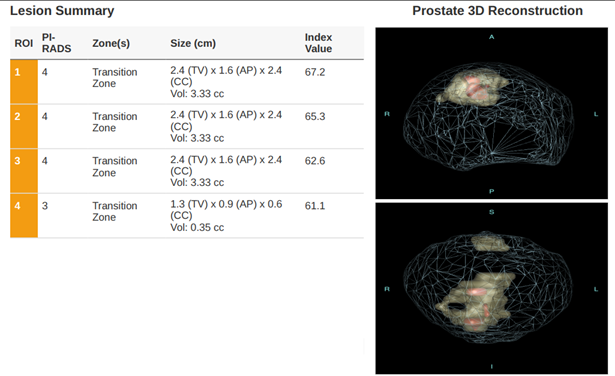
Sample DeepView Imaging Report with Lesions Shown in 3D
An Additional Perspective

A second review can help validate findings and clarify subtle areas of concern before biopsy or treatment decisions are made.
Better Understand Your Risk

Not all prostate cancers behave the same way. A deeper analysis can help distinguish between low-risk and more significant disease.
Decide with Greater Confidence
Major decisions deserve complete information. A second look can provide reassurance and strengthen conversations with your care team.


.svg)

